
The Ultimate Igbo Statement Cap: The Meaning and Beauty of Isi Agu
What Does "Isi Agu" Mean?
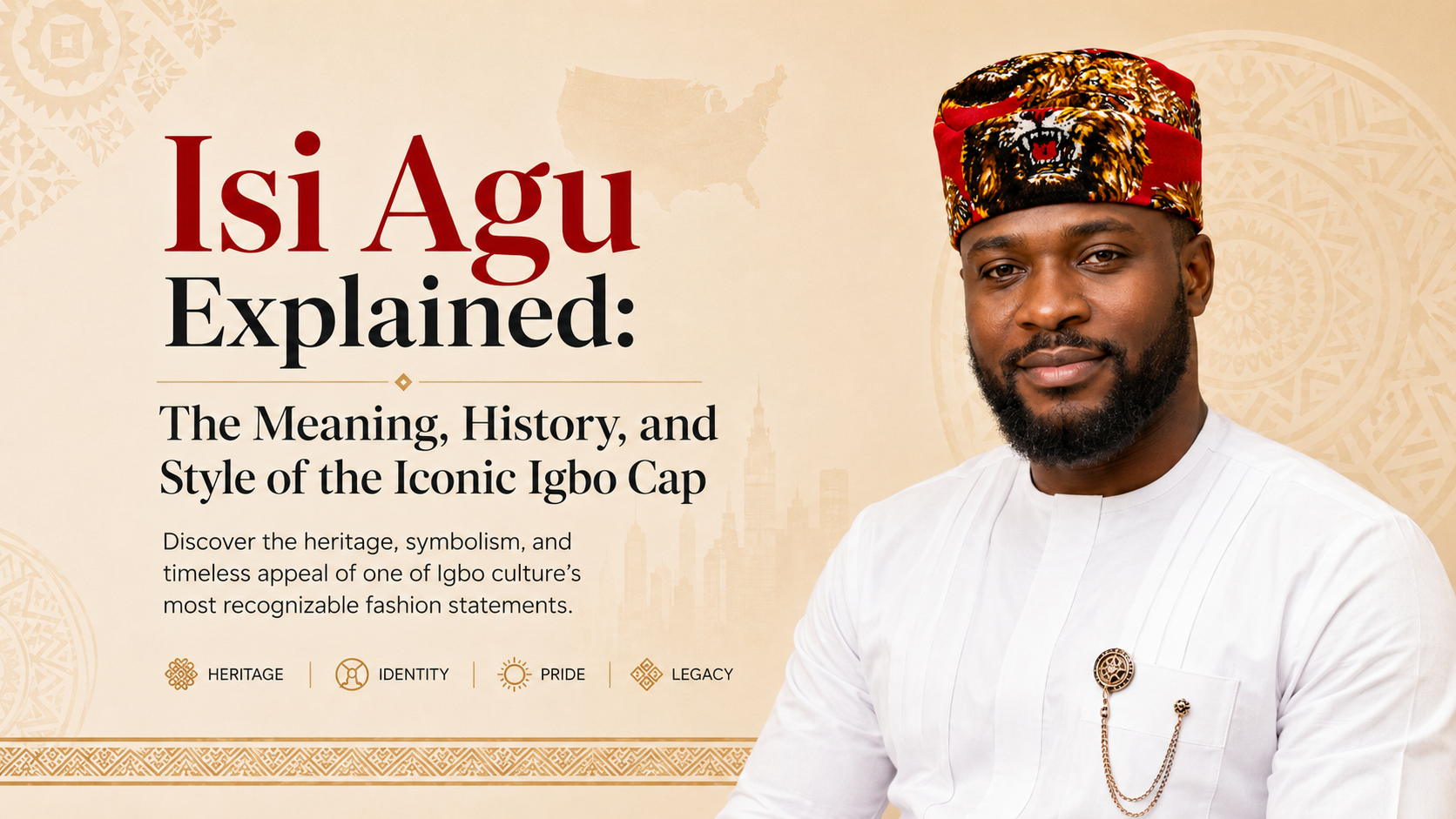
The name is disarmingly direct. In Igbo, isi means “head” and agu means “leopard” or, more loosely, “lion” so Isi Agu translates to “head of the leopard” or “lion-head.” The distinction matters: in traditional Igbo cosmology, the leopard (agu) is the supreme beast of the forest, an emblem of royalty, ferocity, and unassailable authority. To place its face upon your head is not decoration; it is a declaration.
The fabric itself, a deep, rich velvet or brocade printed with repeated leonine heads, mouths agape, eyes blazing, manes cascading is equally known as Isi Agu. The cap is cut from this textile and shaped into the distinctive oval crown that sits atop the head, brimless and bold.
A Cap That Speaks Volumes
In Igbo society, clothing is never merely clothing. It is a grammar, a set of signs that communicate rank, occasion, and moral standing to every eye in the gathering. The Isi Agu cap occupies a particularly high register in this visual language. It is worn almost exclusively by men, and its presence on a man’s head carries rich social meaning:
◆ Nobility and Titled Status: Among Igbo communities, the cap is closely associated with men of title holders of the Ozo, Nze, or other chieftaincy titles. Wearing it signals that a man has been formally recognized by his community as a person of standing.
◆ Masculine Courage: The lion motif is deliberately chosen. It communicates that the wearer is not merely a man, but a man of lion-hearted character; brave, decisive, and worthy of respect.
◆ Ceremonial Readiness: Donning the Isi Agu signals that a man is dressed for a serious occasion no casual wear, but the formal business of community life.
◆ Cultural Pride: In a broader sense, the cap is a flag of Igbo identity worn with pride at occasions where that identity is being celebrated and affirmed.
The Complete Isi Agu Ensemble
The cap is rarely worn alone. At its most complete, it is the centerpiece of a full traditional outfit that layers meaning and textile in careful sequence.
The Isi Agu fabric itself is often used not just for the cap but for the entire outer garment a flowing upper robe or isiagu top draped over the body. Beneath this, the man typically wears a george wrapper (fine imported silk or damask) wound around the waist, descending to the feet in regal folds. The ensemble is anchored with coral bead necklaces and wristbands, coral being sacred among the Igbo, a material of ancestral authority. In the hand, a ceremonial horse-tail staff (ofo) or fan may complete the picture.
When Is the Cap Worn?
The Isi Agu cap graces the most significant moments of Igbo communal life: traditional weddings, chieftaincy title ceremonies, burial rites for elders, the New Yam Festival, Ozo title initiations, community assemblies, Igbo cultural days, and state receptions.
At weddings in particular, the cap plays a starring role. The bride’s father, the groom, and senior male relatives who appear in full Isi Agu regalia collectively elevate the ceremony’s prestige. A room full of men in matching or complementary Isi Agu outfits is a statement: this family has come fully assembled, in dignity and in number.
The Fabric Itself — A Brief History
The textile known as Isi Agu is believed to have emerged into widespread use in the mid-twentieth century, gaining rapid popularity across Igboland as a prestige cloth. While the specific origin of the lion-print design has not been definitively documented, the motif draws on a deep pan-African reverence for the lion and leopard as emblems of kingship, a symbolism shared from the Oba of Benin’s leopard imagery to West African royal courts.
Today, the fabric is produced by textile mills in Nigeria and also imported, with variations ranging from basic polyester prints to sumptuous velvet brocades with raised, three-dimensional lion heads in gold and burgundy. The quality of the fabric, its weight, the sharpness of the print, the richness of the velvet pile is itself a marker of social investment. No cost is spared for an important occasion.
The Cap in the Modern Age
Far from being confined to rural ceremonies, the Isi Agu cap has traveled with the Igbo diaspora to cities and continents far from its Southeastern Nigerian origins. In Lagos boardrooms turned celebration halls, in Houston church basements hosting Igbo cultural nights, in London wedding receptions the cap appears, still carrying its full freight of meaning.
Contemporary Nigerian fashion designers have embraced Isi Agu fabric, incorporating it into modern silhouettes blazers, structured jackets, and tailored caps that blend the traditional motif with current aesthetics. The lion’s face now appears on red carpets and in glossy magazines, wearing its roar with the same unapologetic pride it has always carried.
What is remarkable is how little the cap’s cultural weight has eroded with popularity. Even when worn by a young man who has never undergone a title ceremony, the Isi Agu cap carries with it an aspiration, a reaching toward the dignity it represents. It is the rare garment that bestows gravity simply by being placed on the head.
Wear Your Lion Pride
At Usafricanstore, we offer high-quality, authentic Isi Agu caps that honor this rich Igbo tradition.
🛒 Ready to wear the crown of the lion? Shop Authentic Isi Agu Caps Now
Perfect for weddings, traditional events, or as a powerful statement of cultural pride.🦁🧢
The Isi Agu cap remains one of the most respected and desired pieces in traditional Igbo menswear. Worn proudly at weddings, title ceremonies, and grand celebrations by men who carry the spirit of the lion. Strong. Fearless. Unforgettable.